


MANILA, PHILIPPINES — As artificial intelligence reshapes the communications industry, public relations leaders are emphasizing the importance of human judgment, ethical responsibility, and trust in ensuring technology serves people rather than reducing them to numbers.
Speaking at the 33rd National PR Congress at Solaire Resort North, former Communications Secretary Herminio “Sonny” Coloma Jr. urged public relations professionals to look beyond platforms, metrics, and technology and focus on the people behind the numbers.
The congress, organized by the Public Relations Society of the Philippines (PRSP), carried the theme “Steward the Story: From Clout to Legacy.”
Coloma said the theme goes beyond a professional agenda, framing it as a responsibility to consider how communication influences what people know, believe, trust, and ultimately do.
“In the language of modern communications, people can easily become metrics: reach, engagement, conversion, impressions, click-through rates, sentiment scores,” Coloma said. “Behind every impression is a person. Behind every click is a human being. Behind every community is a family.”
He added: “Behind every consumer is somebody trying to make a decision about what to believe and whom to trust. And behind every follower is a human relationship that can either be strengthened or betrayed.”
Why responsible AI use matters in communications
Coloma highlighted the challenge of maintaining trust as information travels faster than it can be verified and AI generates convincing words, images, and voices at scale.
“AI will make us faster. It will make us more productive. It will help us analyze enormous quantities of information,” Coloma said. “But speed is not wisdom. Automation is not empathy. And information is not trust.”
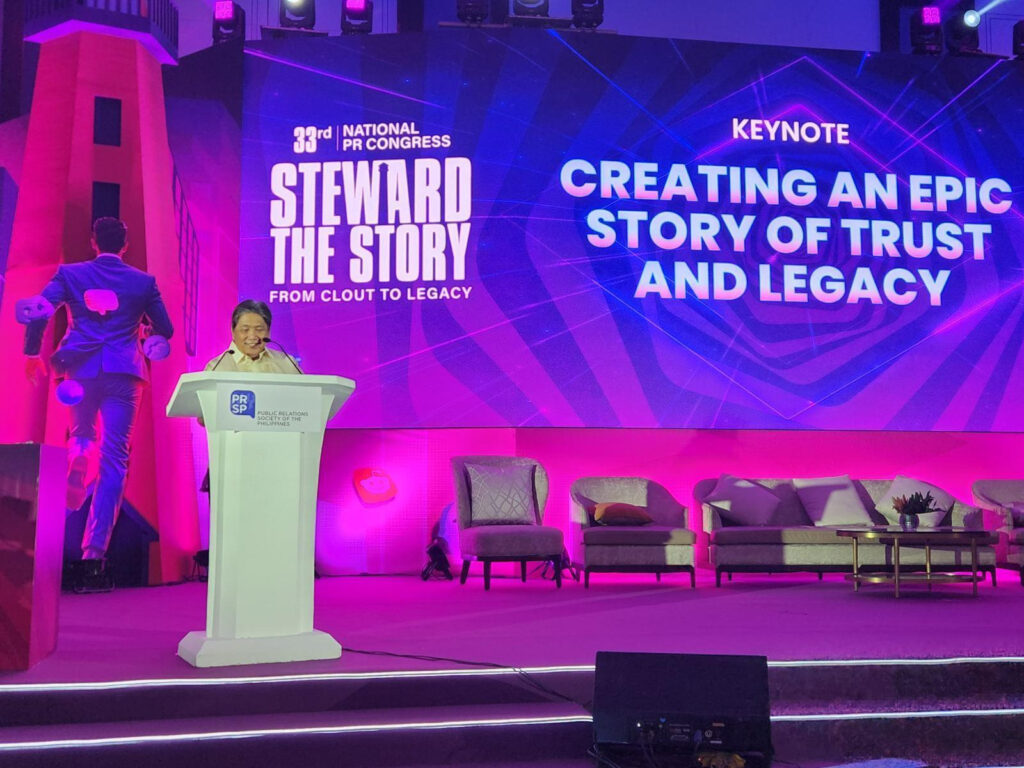
His remarks underscored the need for communications professionals to balance the efficiency of AI with human judgment and ethical responsibility.
As organizations explore AI tools for content creation, information analysis, and other communications tasks, understanding how to use these technologies responsibly becomes increasingly important. The ability to produce content quickly must be accompanied by the ability to assess its accuracy, context, and potential impact on the people who receive it.
For Coloma, trust also depends on whether an organization’s actions reflect the messages it communicates.
He said organizations earn trust when “what they say, do, and stand for are aligned,” arguing that effective PR should not simply make an organization appear better but help it become worthy of the reputation it seeks.
“That is why the best public relations is not simply about telling a better story. It is about helping organizations become worthy of a better story,” he said.
He also urged practitioners to recognize the civic dimension of their work.
“Our profession has a civic responsibility. Because trust is not merely a business asset, it is social capital,” Coloma said.
Coloma cautioned practitioners against allowing technology to reduce people to targets, urging them to “choose credibility over virality.”
“Do not allow technology to turn human beings into targets. Use technology to serve people better,” he said.
“Going viral is not the same as making a difference,” Coloma added. “A million views may disappear tomorrow. A million followers may move on. But one trusted relationship can endure for decades.”
He said the impact of communication should therefore be measured not only by how many people a message reaches, but by what it changes.
“Did people understand? Did they believe? Did they participate? Did behavior improve? Did relationships deepen? Did the institution become more credible? Did society become a little better? Those are the questions of legacy,” Coloma said.
Preparing future PR professionals for an AI-driven industry
The congress also highlighted the need to strengthen professional education as the communications landscape evolves.
PRSP President Ana Pista, APR, said closer collaboration between universities and the PR industry will be important in preparing future practitioners for the changing demands of the profession.
“The future of PR will be shaped by universities and the profession working together to prepare students with the strategic, ethical, and practical skills they need to serve organizations and the public responsibly,” Pista said.
She added: “PR education must prepare students for more than writing and securing publicity. It must develop critical thinking, ethical judgment, an understanding of stakeholders, and the ability to connect communication with organizational goals and public interest.”
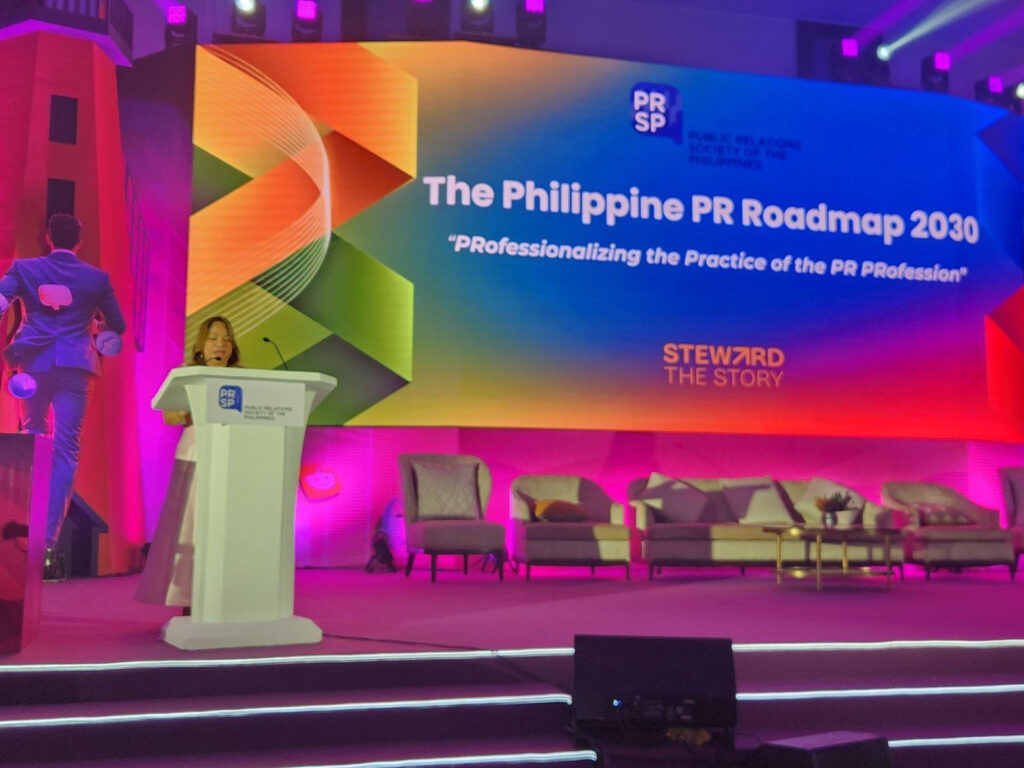
Pista’s remarks highlight the importance of equipping future professionals with skills that extend beyond the use of communication tools. As AI becomes more integrated into professional practice, education must also prepare students to assess information critically, make ethical decisions, and understand the needs of different stakeholders.
These priorities are also relevant to broader efforts to strengthen AI learning and adoption, particularly as organizations and educational institutions navigate the opportunities and responsibilities that come with emerging technologies.
Navigating a changing media environment
33rd National PR Congress Chair Ed Timbungco, APR, said changes in media have likewise increased the need for strategic and responsible reputation management.
“Rapid developments in phy-gital platforms have redefined brand storytelling, challenging us to sharpen our agility in navigating a fragmented, hyper-personalized media landscape,” Timbungco said.
“Nonetheless, our responsibility as reputation managers remains the same — to be authentic to what we stand for as a brand and to continually be intentional in doing our bit in creating a better world, especially for the next generation.”
For Coloma, that responsibility extends beyond winning attention or influencing the immediate news cycle.
“Let us create stories that people can believe. Let us create brands that can withstand scrutiny. Let us create institutions that deserve their reputations. Let us use AI without slandering our humanity. Let us pursue influence without slandering our integrity.”
He closed by urging PR practitioners to think beyond immediate visibility and toward the lasting impact of their work.
“Not merely to be heard, but to be understood. Not merely to persuade, but to build confidence. Not merely to win today, but to leave something worthy for tomorrow.”
Ultimately, Coloma said, the profession must move “from clout to credibility, from visibility to value, from influence to responsibility, from reputation to trust” — and “from a story told to a legacy that is lived.”
As AI continues to reshape communications, the discussions at the congress point to a central challenge for organizations and practitioners: adopting new technologies while preserving the human judgment, ethical standards, and trust that make communication meaningful.