

INDANG, CAVITE — As artificial intelligence (AI) reshapes the communications industry, the AI Centre of Excellence (ACE) highlights the need for continuous skills development, workforce adaptation, and responsible AI adoption to help professionals and organizations navigate technological change.
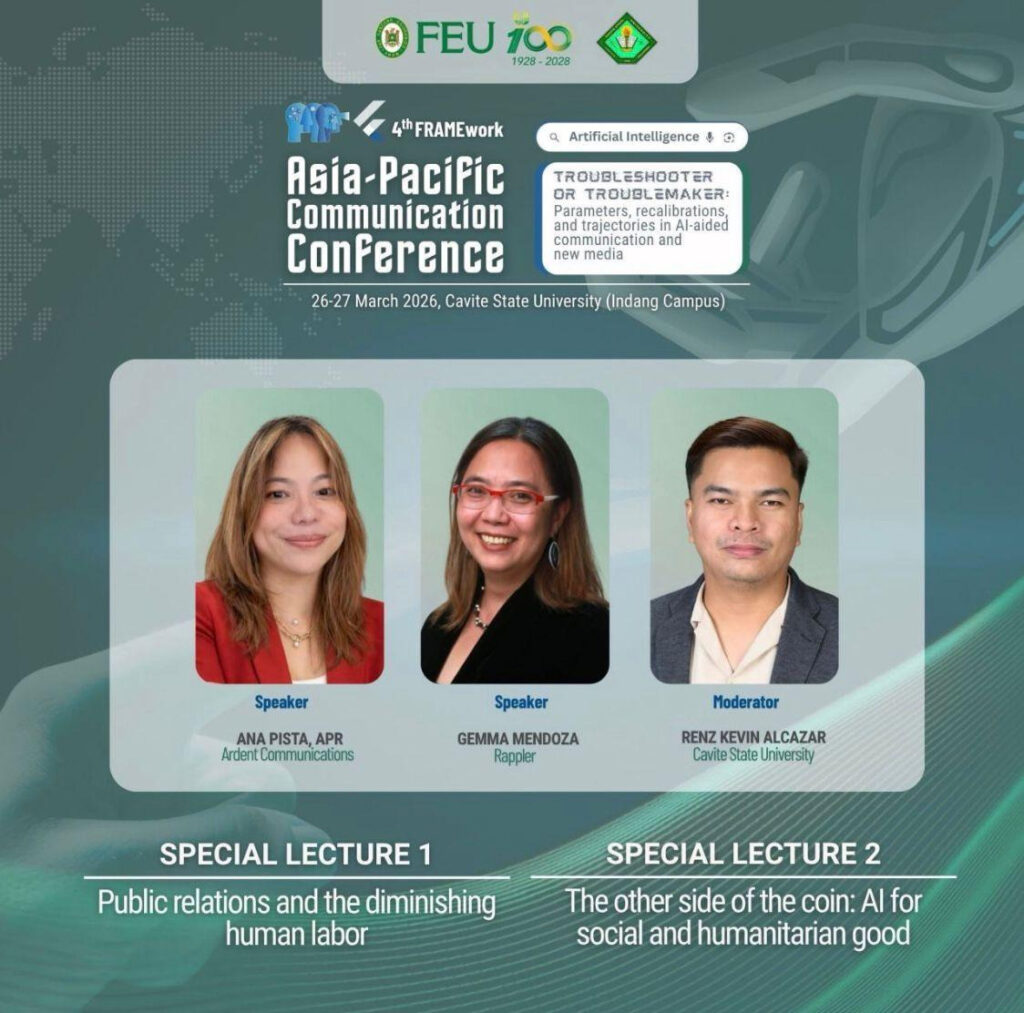
These issues took center stage at the 4th FRAMEwork: Asia-Pacific Communication Conference on March 26, 2026, where industry leaders discussed AI’s impact on employment, ethics, and social good under the theme “Troubleshooter or Troublemaker: Parameters, Recalibrations, and Trajectories in AI-Aided Communication and New Media.”
Ana Ruby Pista, APR, CEO and Co-Founder of ACE, Founder and CEO of Ardent Communications, and President of the Public Relations Society of the Philippines, opened the session with her talk, “Public Relations and the Diminishing Human Labor.” She discussed how AI is changing the public relations profession and why professionals must adapt to remain relevant.

Redesigning roles for an AI-driven workforce
Pista reflected on previous waves of technological change and their effects on employment, drawing a comparison between the introduction of personal computers and the current rise of AI.
“It’s a full circle for me—from the launch of Windows 95 that led to workforce disruption, to today with the arrival of AI,” she said.
She outlined emerging shifts in public relations, including the growing use of answer engine optimization (AEO), chatbots for internal communications, and narrative intelligence for reputation monitoring. These developments are changing the skills communications teams need and how organizations structure their work.
“AI will not replace you. Someone using AI will,” Pista emphasized.
For organizations, this means preparing employees to work with new technologies rather than relying solely on traditional job descriptions and established workflows.
Drawing from her experience at Ardent Communications, Pista explained how the agency developed a quick-reaction team that monitors trends, measures sentiment in real time, and connects campaign activities with changes in brand perception.
“At Ardent Communications, we built a quick-reaction team. Our people don’t just report what happened—we predict trends, measure sentiment in real time, and link campaign activity to shifts in brand perception,” she said.
She also discussed job redesignation, which encourages professionals to develop skills across different communication functions instead of remaining limited to narrowly defined roles.
“Before, we had job titles. Now, we focus on role-playing,” she said. “The question is no longer what your specific role is—but how you diversify your skill sets.”
Under this approach, a communications professional may combine writing, social media management, photography, audience analysis, and AI-assisted content development. This broader skill set allows teams to respond to changing organizational needs while making better use of available technology.
She concluded with a call for professionals to embrace continuous development.
“AI can never replace us if we upskill, adapt, and lead.”
For ACE, these developments highlight the importance of AI learning and industry-focused training that help professionals understand emerging tools and apply them to practical workplace challenges.
Responsible AI adoption requires accountability
The conference also explored the risks of AI adoption, emphasizing that efficiency and innovation must be balanced with ethical safeguards.
Gemma Mendoza of Rappler presented “How Can AI Be Used for Social and Humanitarian Good?” She discussed how AI can support journalism while introducing concerns about misinformation, manipulation, and the unauthorized reuse of newsroom content.
“I don’t want to say AI is clearly good,” Mendoza said, noting that news organizations face challenges such as content scraping, in which AI systems reportedly extract and reuse newsroom material without compensation.
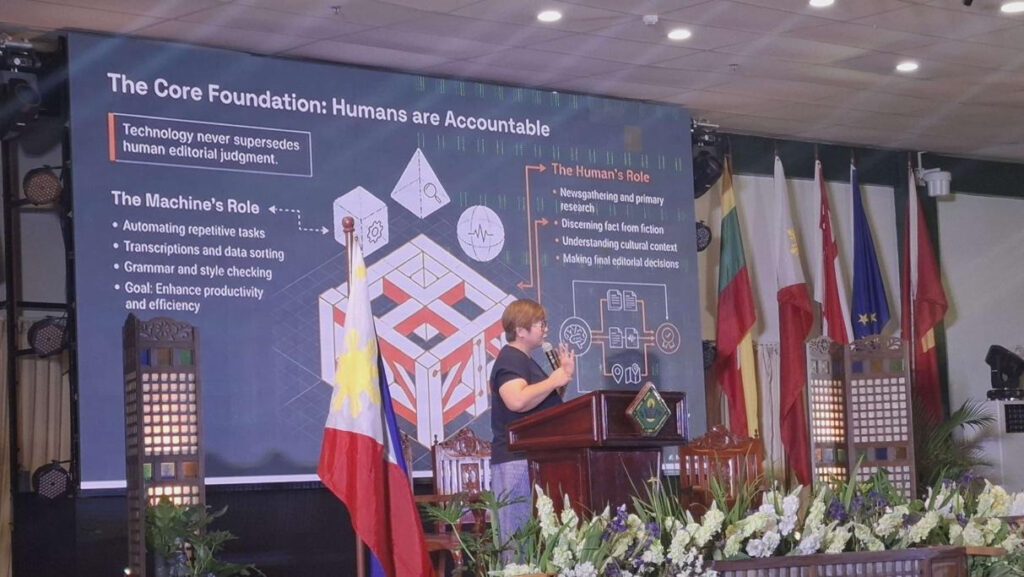
At Rappler, she explained, AI is used for tasks such as transcription, summarization, content-to-video formats, and chatbots that help audiences navigate large volumes of information. The organization is also experimenting with AI to identify patterns across topics that may provide insights for policymakers.
However, Mendoza stressed that organizations must establish safeguards before deploying AI tools.
“The grounding point here that’s needed, before you start anything, is adopting guardrails,” she said.
She added that the development of agentic AI requires organizations to revisit their existing guidelines and establish clear boundaries for its use.
Her discussion reinforced the importance of responsible implementation: organizations need to consider not only what AI can do, but also how its use is governed and who remains accountable for its outcomes.
For organizations exploring AI adoption, this means developing appropriate safeguards and ensuring that human oversight remains part of the process.
Connecting AI education with industry needs
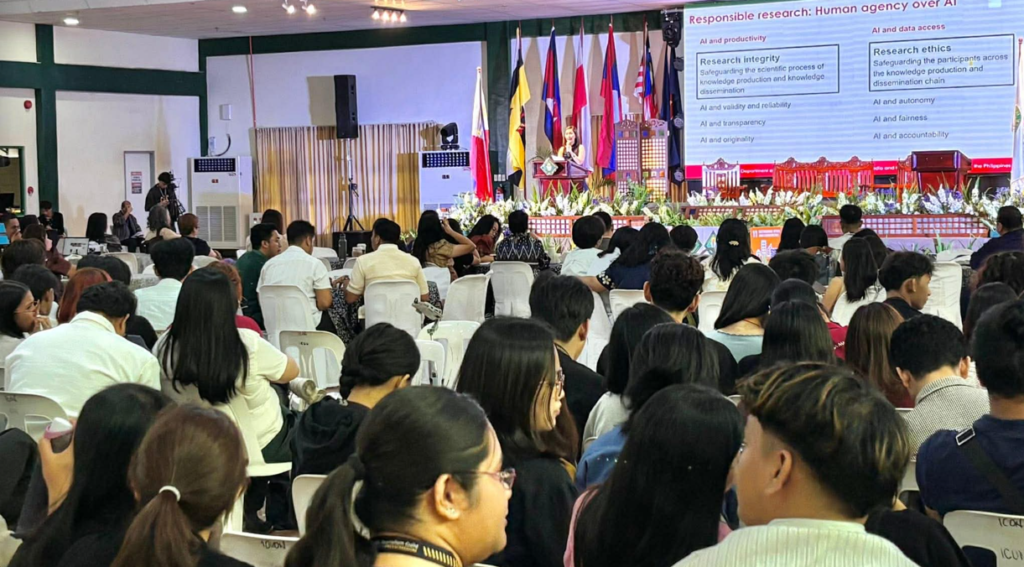
The panel discussion, moderated by Renz Kevin Alcazar of Cavite State University, also addressed the gap between academic preparation and the demands of an AI-driven communications workforce.
Pista noted that many communication graduates eventually pursue careers in public relations despite the limited availability of dedicated PR programs in some institutions.
“We always say that 99% of what you read—whether in social media, print, or online—is PR-generated,” she said. “So why is PR treated as a ‘unit’ rather than a course?”

She warned that without curriculum reform that incorporates AI use, graduates may struggle to compete in an increasingly technology-driven industry.
Mendoza similarly emphasized the need for journalists to develop both storytelling and technical skills.
“In this day and age, you cannot be a journalist who doesn’t know how to look at technology through a critical lens or handle data,” she noted.
The discussion highlighted the importance of AI literacy, including the ability to evaluate AI-generated information, use tools appropriately, and question their outputs rather than accept them without scrutiny.
These priorities align with ACE’s focus on AI learning, research, and collaboration between academia and industry. By fostering connections between educational institutions and organizations, ACE aims to help bridge the gap between AI knowledge and its practical application to real-world problems.
As AI continues to change professional roles and workflows, collaboration between educators and industry practitioners can help ensure that learning opportunities respond to evolving workplace requirements.
Preparing people and organizations for AI-driven change
The discussions at the 4th FRAMEwork Asia-Pacific Communication Conference highlighted two connected challenges: preparing professionals for changing workforce demands and ensuring that AI is used responsibly.
For communications organizations, adapting to AI involves more than introducing new tools. It also requires developing employee capabilities, reconsidering established roles, and establishing safeguards that keep technology aligned with organizational needs and human judgment.
Through its focus on industry-oriented training, research, and workshops, ACE aims to support organizations in adopting AI strategically and responsibly while encouraging collaboration between academia and industry.
As AI continues to evolve, equipping people with the skills to use, assess, and question these technologies will be essential to making their adoption effective and sustainable.
About the Conference
The 4th FRAMEwork: Asia-Pacific Communication Conference serves as a platform for Asia-Pacific scholars and practitioners to share research and explore emerging frameworks in communication and is organized by the Far Eastern University – Institute of Arts and Sciences in partnership with regional academic and professional institutions, including Atma Jaya Catholic University of Indonesia, University of the Thai Chamber of Commerce, Amity University, University of the Philippines Diliman, University of the Philippines Mindanao, Cavite State University, Visayas State University, University of Science and Technology of Southern Philippines, Don Mariano Marcos Memorial State University, the Philippine Association of Communication Educators, and the Asian Network for Public Opinion Research.
About the AI Centre of Excellence (ACE)
The AI Centre of Excellence (ACE) is a specialized AI learning and innovation hub delivering industry-focused training, research, and workshops to help organizations adopt AI strategically and responsibly. Founded in 2025, ACE aims to foster robust collaborations between academia and industry, leveraging AI methods to solve real-world problems.